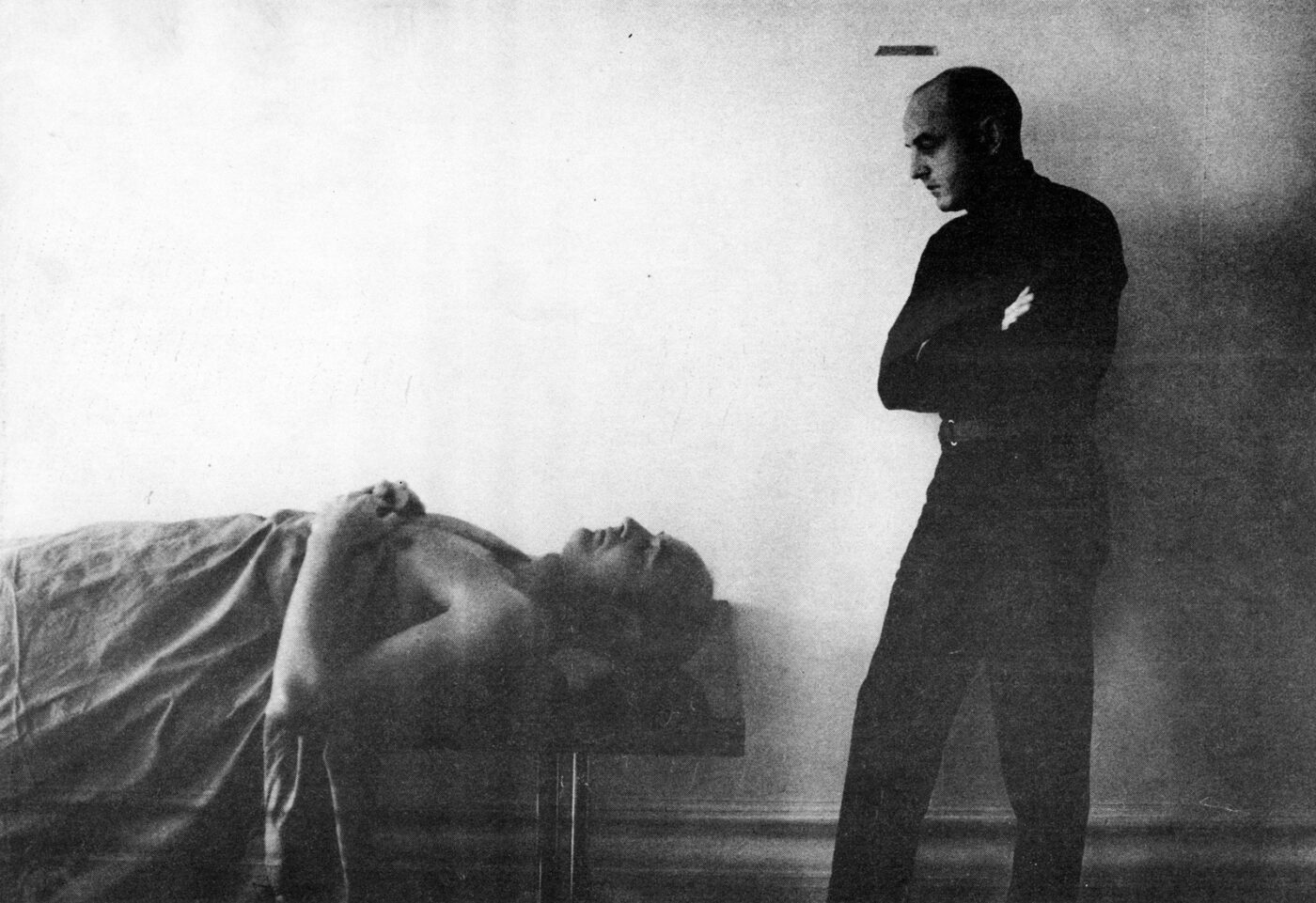
Photography has spent most of its history arguing for itself as a document — proof that something existed, that a moment occurred, that a person was there. Duane Michals was never particularly interested in that argument. For him, the photograph was not a record of reality but a place where reality could be questioned, bent, and pushed toward something it could not normally reach.
The sequences
What Michals is most known for are his photo sequences — small series of images, usually five or six frames, that unfold like a very short film or a dream that has been interrupted. A man walks into a room and slowly disappears. Two people meet and something passes between them that cannot be named. A figure moves through light and shadow and arrives somewhere different from where he started. The sequences do not explain themselves. They present an event that could not happen and treat it with complete seriousness, the way a dream presents the impossible as ordinary. In doing this Michals carved out a space that photography had largely left alone — the interior, the imagined, the felt rather than the seen.
The hand written text
Michals began writing directly onto his photographs — not captions underneath, but handwritten text across the image itself, in his own unpolished script. The words are sometimes confessional, sometimes philosophical, sometimes tender, sometimes funny. They do not describe what is in the photograph. They complicate it, argue with it, or go somewhere the image alone cannot go. This was a radical gesture at the time and still feels like one. It refuses the idea that a photograph should speak for itself, or that it even can. Michals understood that images have limits, and rather than pretending otherwise he made those limits part of the work.
The subjects
Michals returned throughout his career to a set of recurring preoccupations — death, desire, memory, identity, the relationship between the visible and the invisible. He photographed ordinary people in ordinary rooms and asked them to perform situations that had no name. He made portraits that feel less like likenesses and more like encounters. His portrait of René Magritte — the Belgian surrealist who was also obsessed with the gap between image and reality — is one of the great photographs of one artist fully understanding another. Two people who had spent their careers asking the same question, briefly in the same room.
The attitude
What runs through all of it is a particular attitude toward the medium — affectionate but unconvinced. Michals loved photography and did not fully trust it, which put him in a more honest relationship with it than most. He understood that a photograph cannot show you what a person felt, cannot show you what happened before or after, cannot show you anything that was not already on the surface. And so he spent his career finding ways to smuggle in everything the photograph could not hold — through sequence, through text, through staging, through the willingness to look foolish or sentimental or strange in pursuit of something true.
He was also consistently funny, which is underrated. Not many photographers are genuinely funny. Michals used humor the way the best writers use it — not to deflect from seriousness but to arrive at it from an unexpected angle.
Duane Michals did not change what photography looked like so much as he changed what people thought it was allowed to do. That is a quieter kind of influence, but a lasting one.