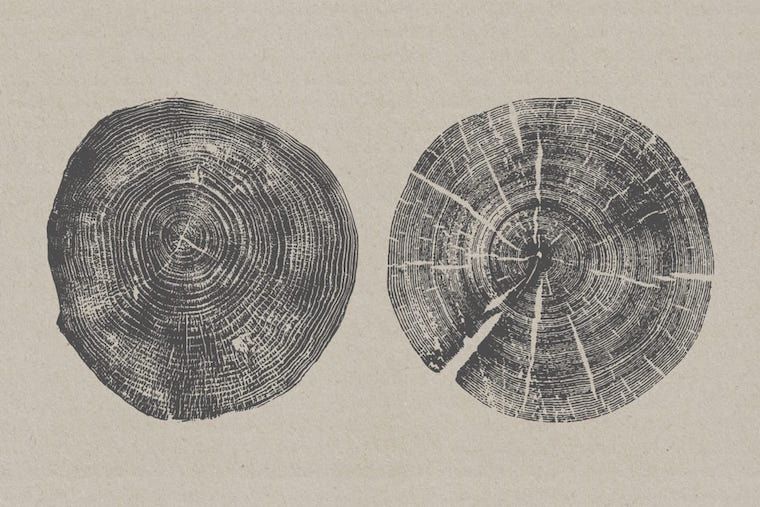
Wabi-sabi is a Japanese aesthetic philosophy built around a simple and deeply uncomfortable idea — that impermanence is not a problem to be solved but a truth to be accepted, and that beauty is most honestly found in things that show their age, their damage, and their transience. It is the opposite of the impulse to preserve, to restore, to make new again.
The two words
Wabi and sabi arrived as separate concepts before they merged. Wabi originally referred to a kind of loneliness — the particular solitude of living simply, away from the world, without comfort or distraction. Over time it softened into something closer to the finding of richness in simplicity, the beauty of the modest and the imperfect. Sabi referred to the patina of time — the rust, the fade, the crack, the way things change as they age and in changing become more honestly themselves. Together they describe an attitude toward the world that is at once melancholic and deeply at peace.
What it looks like
A tea bowl that is not perfectly round. A wall where the plaster has cracked and not been repaired. A piece of wood worn smooth by decades of hands. A garden where things are allowed to grow and die and grow again without too much intervention. Wabi-sabi aesthetics tend toward the asymmetrical, the rough, the modest, and the incomplete. Not because perfection is wrong but because perfection is dishonest — it denies the reality of time, which touches everything and changes everything and cannot be argued with.
The traditional Japanese tea ceremony is one of the fullest expressions of wabi-sabi in practice. The tea room is small and deliberately humble. The utensils are often old, irregular, repaired. The experience is slow and quiet and asks you to be fully present in an impermanent moment rather than trying to hold onto it or improve it.
Kintsugi
The most well known expression of wabi-sabi is probably kintsugi — the practice of repairing broken ceramics with gold lacquer, making the cracks visible and precious rather than hiding them. A kintsugi bowl is more beautiful than an unbroken one, not despite what happened to it but because of it. The damage is not erased. It is acknowledged, honored, and made part of what the object is. There is an obvious human parallel that does not need to be overstated.
What I ask of you
Wabi-sabi is not simply a design preference. It is a practice of perception that requires a genuine shift in what you are looking for. The modern eye, trained on the new, the smooth, the optimized, has to learn to stop and look differently — to find the interesting thing in the faded rather than the fresh, to sit with imperfection rather than immediately wanting to correct it.
This connects to what the best photographers, filmmakers, and artists have always understood. Texture, age, wear — these are not obstacles to beauty but the conditions under which a particular kind of beauty becomes possible. The beauty that only arrives after time has been allowed to do its work.
Wabi-Sabi and grief
There is something in wabi-sabi that speaks directly to loss. The philosophy does not ask you to be happy about impermanence. It asks you to stop being surprised by it. Things end. People leave or die. Relationships crack. The wabi-sabi response is not to pretend otherwise or to rush toward restoration, but to look honestly at what remains and find that it still has value — perhaps more value, because now it is real in a way that untouched things are not.
Cohen understood this. Wenders understood this. Michals understood this. The worn surface, the honest crack, the thing that has survived its own damage — this is where the most truthful work tends to live.
Wabi-sabi does not promise comfort. It promises something more durable than comfort — a way of seeing that does not require the world to be other than it is.